What to Do If Your Car Breaks Down on a Highway in Queensland
Broken down on a Queensland highway? Learn where to stop, whether to leave the car, who to call and what to do while waiting for roadside assistance.
· The Roadside Guy
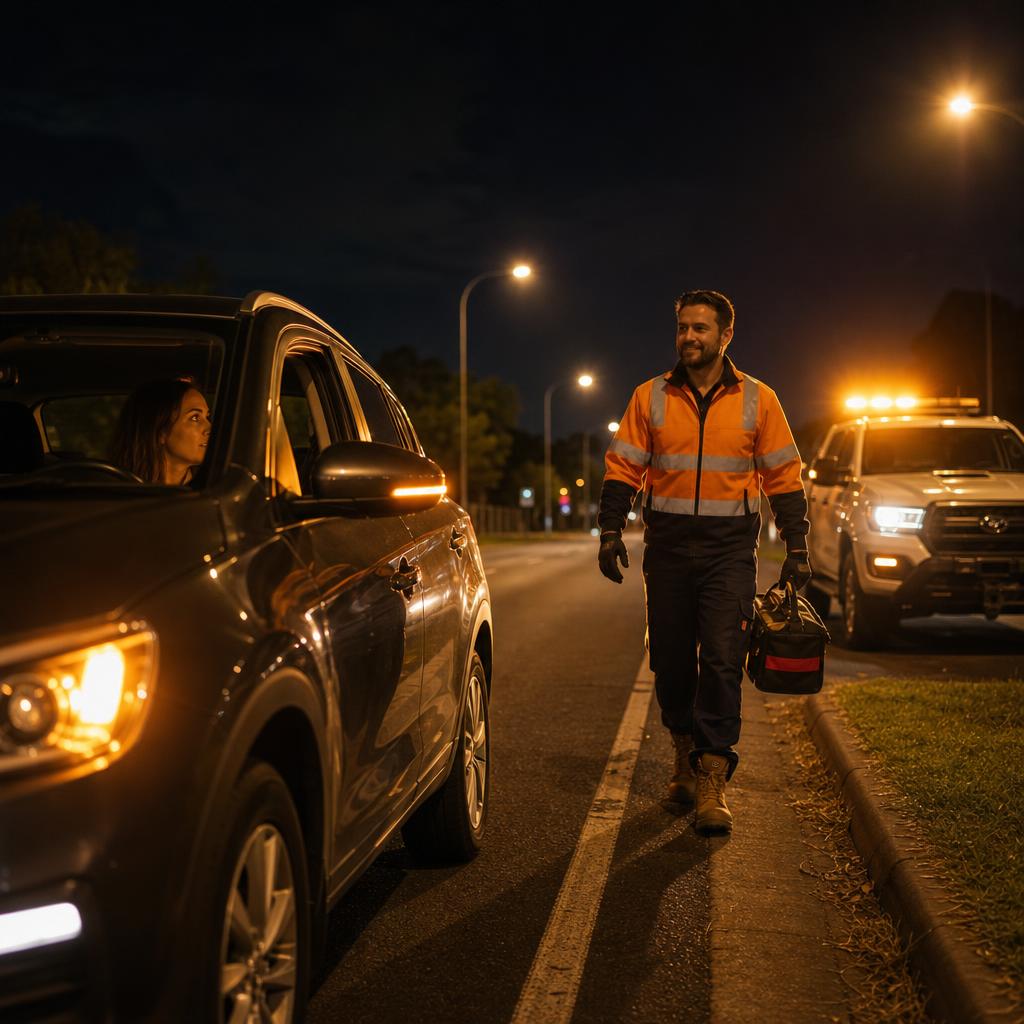
What to Do If Your Car Breaks Down on a Highway in Queensland
Brooke was taking her daughter to an appointment when a small piece of metal turned an ordinary drive into exactly the sort of situation motorists hope never happens: a rear tyre blew while they were travelling in the middle lane of the Ipswich Motorway.
She managed to get the car onto the shoulder without a crash. RACQ later published her account, and because the vehicle had stopped in a dangerous location, roadside help was sent to get them out of the situation.
The mechanical problem was one tyre.
The real danger was everything around it.
That is what makes a highway or motorway breakdown different from breaking down in a driveway, shopping-centre car park or quiet suburban street. On roads such as the Logan Motorway, Pacific Motorway, Gateway Motorway and Ipswich Motorway, traffic can be moving past at highway speed while you are trying to work out what has gone wrong.
The first question should not be, “Can I fix this?”
It should be, “How do I make this situation as safe as possible?”
Queensland Transport and Main Roads publishes specific breakdown-safety advice for this reason. Here is what to do if your car breaks down on a highway or motorway in Queensland.
If the Car Is Still Moving, Use That Opportunity
A breakdown does not always mean the engine stops instantly.
You may notice a warning light, loss of power, vibration, unusual noise, rising temperature or a tyre beginning to fail while the vehicle can still move.
If you can safely leave the highway or reach a breakdown bay before the vehicle stops, do so.
Transport and Main Roads advises motorists to avoid stopping on highways where possible and to attempt to exit the highway when early signs of a problem appear.
If you cannot get off the road completely, move as far to the left and as far away from moving traffic as conditions safely allow.
Turn your hazard lights on as soon as you realise there is a problem. At night, leave your parking lights on as well.
Once you are stopped, apply the handbrake and turn the wheels away from traffic.
The important point is simple: use whatever safe movement you still have to improve where the car comes to rest.
Do not keep driving purely to save yourself the inconvenience of stopping. A manageable problem can become a much more serious mechanical failure — or leave you stranded somewhere worse.
Once You Stop, Decide Whether It Is Safer to Stay In or Get Out
There is no universal rule that says you should always stay inside a broken-down vehicle or always get out.
Queensland's official guidance says to assess the surrounding environment first.
If it is safe to leave the vehicle, drivers and passengers should exit from the passenger side where possible, away from traffic, and move behind a roadside barrier or as far away from traffic as reasonably possible.
If it is not safe to exit, stay in the vehicle and make sure everyone has their seatbelt securely fastened.
That distinction matters.
A car fully inside a breakdown bay with a barrier nearby is very different from a vehicle stopped on a narrow shoulder with traffic passing centimetres away. Do not expose yourself to live traffic simply because you feel you are supposed to get out.
If children or pets are with you, keep them under close control and well away from the roadway if you do leave the vehicle.
A Highway Shoulder Is Not a Workshop
Knowing how to change a tyre does not mean you should change one everywhere.
The same applies to opening the bonnet, connecting jumper leads or crawling around the vehicle trying to identify a problem.
If traffic is passing close to the vehicle, the safest decision may be to leave the repair alone and wait for professional assistance or traffic management.
This is particularly important with a flat tyre. A wheel change requires you to spend time beside the vehicle, often crouched down and concentrating on the wheel rather than the road behind you.
If the vehicle is in a safe position and the roadside environment allows the work to be carried out safely, flat tyre assistance can help with fitting a safe, serviceable spare wheel.
If the location is not safe enough to work in, the priority is getting the vehicle and its occupants out of danger — not getting the spare tyre fitted immediately.
The same principle applies to a flat battery. A mobile jump start service makes sense when the vehicle is somewhere suitable for roadside work. It does not make sense to stand around a dangerous motorway shoulder attempting a DIY jump start simply because you have leads in the boot.
Who Should You Call?
The right call depends on the situation.
If there is an immediate emergency
Call Triple Zero (000) if there is a genuine emergency requiring police, fire or ambulance assistance, including serious injury or an immediate threat to life.
If you are broken down on a major Queensland road
Queensland Transport and Main Roads operates the 13 19 40 traffic hotline.
The number can be used to report road incidents and to seek assistance with a breakdown or minor traffic incident on a major Queensland road. Traffic management centres operate around the clock and can coordinate responses to incidents across the road network.
This can be particularly important if your vehicle has stopped in a dangerous position or is affecting traffic.
If the situation is safe and mechanical
Call your roadside assistance provider.
If you are in Logan or Brisbane Southside, you can also view The Roadside Guy's roadside assistance services for problems such as flat batteries, flat tyres, emergency fuel and other common roadside issues.
Give the Person Helping You a Useful Location
"I'm on the motorway near Logan" can still leave a very large search area.
Before you call, take a moment to work out exactly where you are.
Useful details include:
- the road or motorway name
- your direction of travel
- the nearest exit
- the last suburb or interchange you passed
- kilometre markers, if present
- a nearby overpass, bridge, service station or landmark
- a location pin from your phone's maps app
For example:
"I'm on the Logan Motorway heading east, just after the Wembley Road exit."
That is far more useful than:
"I'm somewhere around Logan."
If you have mobile data, sharing a location pin can remove much of the guesswork.
If you do not have reception, do not start walking along a motorway looking for signal or a telephone. Transport and Main Roads specifically advises motorists not to walk along highways or motorways looking for help. Stay with the vehicle in the safest position available and wait for assistance.
What Should You Do While You Wait?
Once help has been arranged, avoid turning the waiting period into a new risk.
If you are outside the vehicle, remain behind a barrier or well away from the road where possible.
If you have determined that remaining inside is safer, keep your seatbelt on.
Keep your hazards operating. At night, keep your parking lights on as recommended by Queensland's breakdown-safety guidance.
Keep children and pets secured and away from traffic.
Conserve your phone battery, particularly if you may be waiting for a while. Avoid unnecessary video streaming, gaming or anything else that can flatten the phone you may still need for calls or location updates.
Most importantly, do not walk along the motorway or stand beside the car watching for the roadside vehicle to arrive.
Let the person attending come to you.
Why Roadside Position Matters More Than the Fault
Another RACQ member story illustrates this particularly well.
Ashleigh described breaking down close to traffic after an engine problem. While the tow operator was loading the vehicle, a passing car struck the tow truck's side mirror.
Nobody needs to exaggerate the lesson in that story.
Even a professional roadside vehicle with warning lights and an operator who works around traffic can be exposed to passing vehicles. For an ordinary motorist standing next to a passenger car, there is even less protection.
So if someone attending your breakdown tells you the vehicle cannot safely be repaired where it sits, that is not an inconvenience to argue with.
Sometimes the safest roadside repair is no roadside repair at all until the vehicle is somewhere safer.
The Most Common Breakdown Problems Are Often Simple Ones
A car does not need a destroyed engine or gearbox to leave you stranded.
Common roadside problems include flat batteries, tyre and wheel problems, accidental lockouts and running out of fuel.
RACQ reported that battery issues were its largest roadside callout category in a previously published 12-month breakdown snapshot, followed by wheel or tyre problems and accidental lockouts.
That is useful because many roadside problems are relatively straightforward once the vehicle is in a safe place.
Flat battery
A battery can become weak gradually before finally refusing to start the engine. Slow cranking, intermittent starting issues or electrical accessories behaving strangely can be warning signs.
If the vehicle is positioned safely, a jump start service may be enough to get it running, while battery testing can help determine whether the battery itself is likely to be the underlying problem.
Flat tyre
If you have a safe, serviceable spare wheel and the vehicle is in a suitable location, a spare can often get you mobile again.
The key phrase is suitable location.
A spare wheel is not worth standing beside high-speed traffic for.
Out of fuel
It happens.
A misleading fuel gauge, missed service station or simply stretching the tank a little too far can leave a vehicle stranded.
Do not walk along the highway carrying a fuel container. If the vehicle is in a safe position, emergency fuel delivery may be an option; otherwise the priority is safely managing the breakdown first.
Five Things Worth Doing Before Your Next Highway Trip
You cannot prevent every breakdown, but you can make one much easier to deal with.
Before a longer drive:
- Make sure your phone is charged.
- Save the numbers you may need, including your roadside provider and 13 19 40.
- Check that your spare tyre is actually inflated and serviceable.
- Keep a high-visibility vest and torch in the vehicle.
- Pay attention to warning signs from the car rather than waiting for them to become failures.
Queensland Transport and Main Roads includes a charged phone, roadside contacts, a high-visibility vest and a torch among its recommended breakdown preparations.
They are small things to organise at home.
They become much more valuable when you are standing beside a car that will not move.
Broken Down Around Logan or Brisbane Southside?
If you are safely stopped and the problem is something that can be dealt with roadside, The Roadside Guy provides local assistance for common breakdown problems around Logan and Brisbane Southside.
You can view all roadside assistance services, including jump start assistance and flat tyre assistance.
If the vehicle is somewhere unsafe, tell us that when you call. The first priority is working out how the situation can be handled safely.
A flat tyre, dead battery or empty fuel tank can be sorted out.
Standing in the wrong place beside a motorway is the part you cannot afford to get wrong.
---
Sources and further reading
- Queensland Government, Reporting traffic incidents and how we respond: https://www.qld.gov.au/transport/vehicle-safety/crashes-and-breakdowns/reporting-traffic-incidents
- Queensland Transport and Main Roads, Breakdown Safety Glovebox Guide: https://www.tmr.qld.gov.au/-/media/Travelandtransport/Roadandtrafficinfo/Incidents/breakdown-on-motorway/Breakdown-safety.pdf
- RACQ, 100 years of roadside stories: https://www.racq.com.au/car/roadside-assistance/100-years/100-years-of-stories
- RACQ, Top ways Qlders breakdown, and how to avoid one: https://www.racq.com.au/news/motoring/top-ways-qlders-breakdown-and-how-to-avoid-one